
Wednesday, November 13, 2013

Tuesday, November 12, 2013
Bang for the Buck: Efficiently Training and Motivating Collectors
 |
| Image courtesy of jscreationzs / freedigitalphotos.net |
Debt
collection, like any other business, has a skill set. Not everyone is born with the proper skills
and mindset that make an effective collection professional and even those who
do have the right mix of mental and emotional attributes still require training. Many collection agencies – especially smaller
shops – struggle with staff turnover and the sense that they waste hundreds of
hours and untold amounts of money and resources training collectors who then
leave the industry shortly thereafter.
Typically, this sort of turnaround can be traced right
back to the training the collectors are given.
Here are some simple suggestions to reduce staff turnover and make sure
you’re getting the most ‘bang for your buck’ when it comes to training and
motivating your collection staff.
·
Educate. Training can’t
simply consist of handing your new hire a stack of documents to read and
sending them on their way. An effective
collector has to know the laws of your area and the policies and culture of
your company. Take the time to educate
them. It will pay dividends.
·
Foster Communication. Collections
can be a competitive field, and offering rewards for volume is always a good
idea. But you can’t allow your
collectors to become solo agents, cut off from each other. Weekly meetings where communication is encouraged
are essential, as your collectors can learn from each other’s successes – and
failures.
·
Keep Goals Realistic. Setting
goals for your collectors is a tried-and-true motivational tool, but you have
to make these goals individual and realistic.
Tailor goals to the collector’s experience, prior record, and
personality. A little stretching is
good, but a goal that is absolutely unreachable doesn’t motivate, it depresses.
·
Talk to Your Collectors. Getting them
to discuss business between themselves is good for education and shared
experience, but you should make sure you touch base with your staff and make
them feel valued, as well as to review their load and advise them on tactics
and where they may be going wrong.
A motivated staff will clear more paper; it’s a simple
fact of life.
Wednesday, November 6, 2013

Tuesday, November 5, 2013
FTC and CFPB Affecting Collections Large and Small


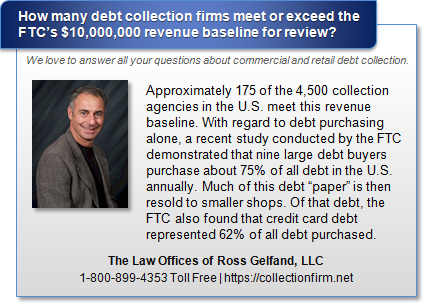
The recent change in focus and attitude on the part of the Federal Trade Commission (FTC) and the Consumer Financial Protection Bureau (CFPB) has brought an aggressive new strategy from the Federal Government against the tactics and business practices of collection agencies and related industries such as debt relief companies. While the new rules and policies were welcomed by consumer advocates who have long complained that debt collection has been existing in a quasi-legal and certainly immoral space for some time, the new policies at first seemed to focus only on the larger firms that had revenues of $10,000,000 and up. Many consumer advocates were unhappy with this baseline as it meant the vast majority of agencies would be excluded from review, as only 175 out of approximately 4,500 collection firms meet the revenue baseline.
However, in the months since the new rules went into effect, it’s become clear that this aggressive new policy will affect the smaller collection agencies that don’t meet the revenue baseline just as heavily. This has been demonstrated in two ways, direct and indirect.
Directly, the FTC and CFPB have brought several complaints and suits against smaller agencies in Florida and California in recent months, seeking judgments for violations including charging fees for debt relief services and improperly withholding information from consumers. Many of the firms targeted do not meet the revenue baseline.
Indirectly, the tightened rules and renewed focus have impacted the smaller collection shops and collection law firms by a trickle down affect. Hence, a large collection agency that is subject to the new rules will have to insure their subcontractors all meet the new stringent guidelines. Therefore, smaller collection firms are now impacted—therefore their bottom lines are being negatively affected as well. Poorly documented or contested debts that were previously sold to smaller shops as well as larger firms are now being sold more or less solely to the largest debt firms in the country. The result is that smaller collection agencies do not have access to a great deal of the existing collectible debt. As a result, even without direct action from the Federal Government, the smallest debt collection shops are suffering a sizable reduction in business.
Tuesday, October 22, 2013
International Debt – A Growing Area of Collections

Today’s marketplace is becoming increasingly global. With the rise of the Internet, it is possible
for businesses to operate virtually everywhere.
This is a profitable turn of events, but it can also mean that a
business is left with payments owed by consumers in other countries. As each nation has its own laws, it can be
tricky or time-consuming to collect on the debt of customers in other
countries.
If a business has significant international debt, it may be a good
idea to bring in a collection firm. The
attorneys in a collection firm may be better equipped to collect on
international debt because they can easily access and better understand the law
specific to each country in which the debtor resides. An attorney may also have more time to work
within the time zone differences inherent in dealing with debtors overseas –
assuring that attempts to contact the debtor do not violate that country’s
collection laws.
A collection firm is also more likely to have the resources to deal
with the foreign language issues that come up in dealing with international
debt. It is often the case that the
business owner does not have the staff or resources to spend time reaching
debtors in Asia or Europe or Africa. Even once the debtor is reached,
understanding must be achieved.
It may be necessary to actually file suit against the debtor, as the
customer is unlikely to take informal collection efforts as seriously as legal
action. In this case, it is essential to
have an experienced lawyer, who is informed about diverse international
collection laws, handle the case. A
collection firm that handles international debt is likely to be well versed and
very busy, as it is not a huge area of practice in the US.
It would be wise for a business to utilize a proper collections attorney
for collecting on international debt, creating the best
possible settlement on the debt.
Wednesday, October 16, 2013

Tuesday, October 15, 2013
How the TCPA and FDCPA are Affecting Consumer Collections in a High Technology Environment

No matter who is making an effort to collect on a debt, there are very
specific laws that must be followed. The
Telephone Consumer Protection Act (TCPA) sets forth some very specific provisions
that may make it very difficult for a company to use automated technology to
collect on debt.
One example of how the TCPA affects collections is that it prohibits
automated recordings or any artificial voices to call any cellular phone
without getting the express permission from the Debtor. In an age when home telephone service is
becoming obsolete, and most Americans carry only a cell phone, this law can
cause a serious impediment to any automated collection efforts. If an agency does violate the TCPA—the
penalties are severe-$500.00 per automated call plus attorneys fees and maybe
even punitive damages or a class action lawsuit.
In addition, the FDCPA requires a (FOTI) message be left when leaving
any message which basically states that
certain identifying information be provided when leaving a message with a
debtor – name of caller, name of entity, and the phone number or address of the
entity – leaving the indebted party unlikely to return the message and pay the
debt . It also opens up the collecting entity to potential third part
disclosure lawsuits as well.
Despite an ever-automated world, federal regulations such as the TCPA
and FDCPA are making automated collections more and more difficult. This means that your business or the
collection firm you have hired will need to use more non-automated resources,
such as having staff on hand to place the calls, and lawyers with specific
knowledge of collection law. This will
ensure that in the process of collecting the debt, no fines will be incurred,
and the settlement will be worth the time, effort, and money expended to
retrieve the debt.
Subscribe to:
Posts (Atom)